
Comparison of the BRCGS Global Standard Agents and Brokers Issue 3 with the new SQF Code: Agents & Brokers
New SQF Code challenges the established BRCGS Agents & Brokers Standard
By Tony Connor
The BRC developed their first Agents and Brokers Standard following the horsemeat scandal in the UK, when it identified the weak link in the supply chain as the lack of traceability back to source for food products.
Now owned by BRCGS, the current version of standard is issue 3 and order to achieve certification, Agents & Brokers needed to demonstrate that they manage product authenticity, quality, legality and safety effectively and meet customer requirements.
The recent publication of an Agents & Brokers Food Safety Code by the SQFI brings a new challenge to this established BRCGS Global Standard Agents and Brokers Issue 3. Here we take a look and compare the two.

About the BRCGS Global Standard for Agents and Brokers Issue 3
First published in 2014, the BRCGS Global Standard Agents and Brokers specifies requirements for managing product safety, authenticity, quality and legality for businesses in the food industry that buy, sell or facilitate the trade of products, but do not manufacture, process or store the products in their own facilities or on their own sites. Approximately 680 Agents or Brokers are certified to this standard.
BRCGS Agents and Brokers Standard covers certification for the following categories of products:
Food products, including raw materials, processed foods, and fruit and vegetables
Packaging materials – primary, secondary and tertiary materials, and raw materials for the manufacture of packaging materials
Pet foods for domestic animals
Consumer products
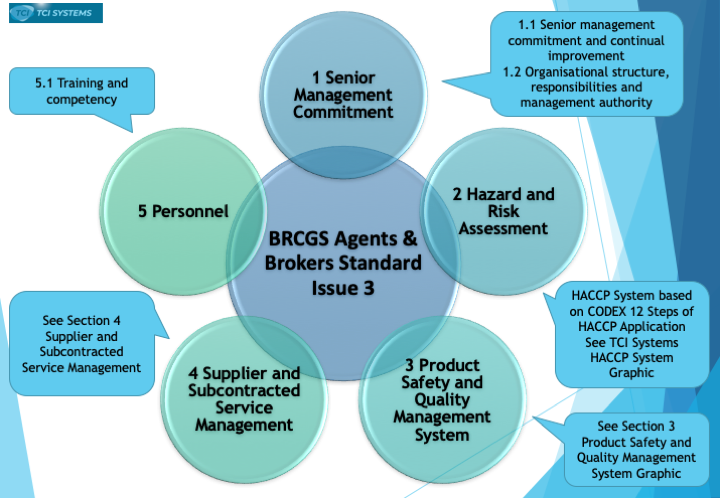
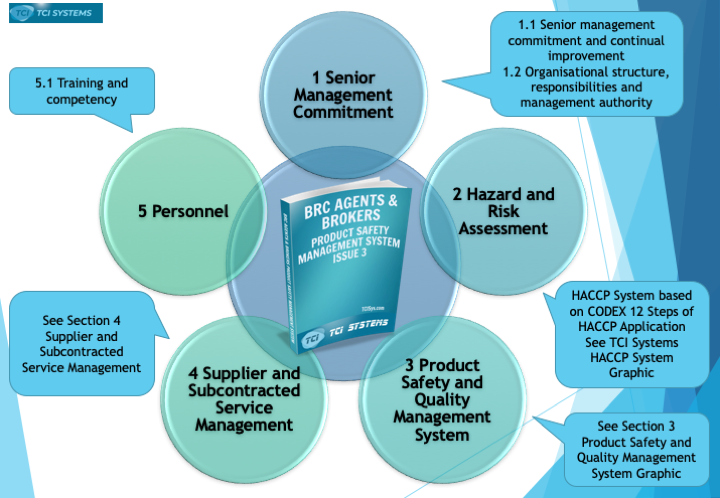
The BRCGS Global Standard for Agents and Brokers Issue 3 has requirements in 4 main areas:
Senior Management Commitment and Continual Improvement
Hazard and Risk Assessment
Product Safety and Quality Management System
Supplier and Subcontracted Service Management
For further information see our Implementation Guidance for BRCGS Agents and Brokers
About the SQF Agents & Brokers Code
The SQF Agents & Brokers Code was published in July 2026 and is a dedicated certification standard for businesses that buy, sell, and manage the trade of food and general merchandise without physically handling the products.
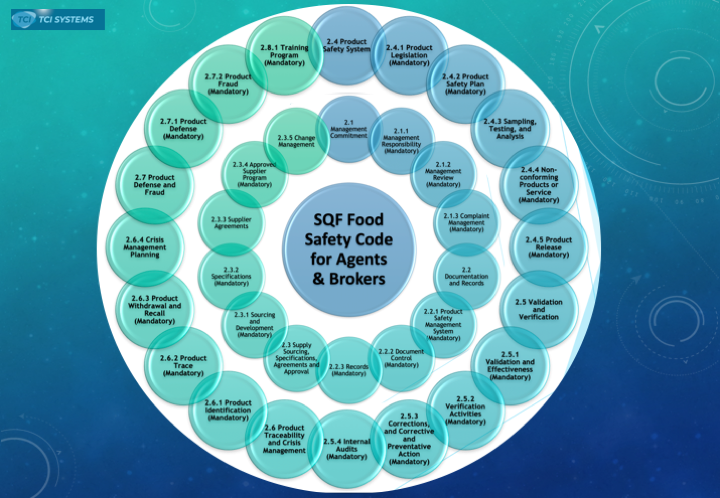
The requirements of the SQF Code Food Sector Category 35 – Agents and Brokers, Edition 9 are all included in Module 2: System Elements:
2.1 Management Commitment
2.2 Documentation and Records
2.3 Supply Sourcing, Specifications, Agreements and Approval
2.4 Product Safety System
2.5 Validation and Verification
2.6 Product Traceability and Crisis Management
2.7 Product Defense and Fraud
2.8 Training
The SQF Agents and Brokers certification was designed so that it can be completed 100% remotely, saving thousands of dollars on audit fees.
All audits are annual and announced in advance, with no unannounced audits unless specifically requested by your business or a customer. Audit duration is a minimum of half a day, with the certification body determining the final length based on the size and complexity of your operations.
See Introducing the SQF Agents & Brokers Code: What It Is, Why It Matters, and How to Get Started for more details
Comparing the BRCGS Global Standard for Agents and Brokers with the SQF Code: Agents & Brokers
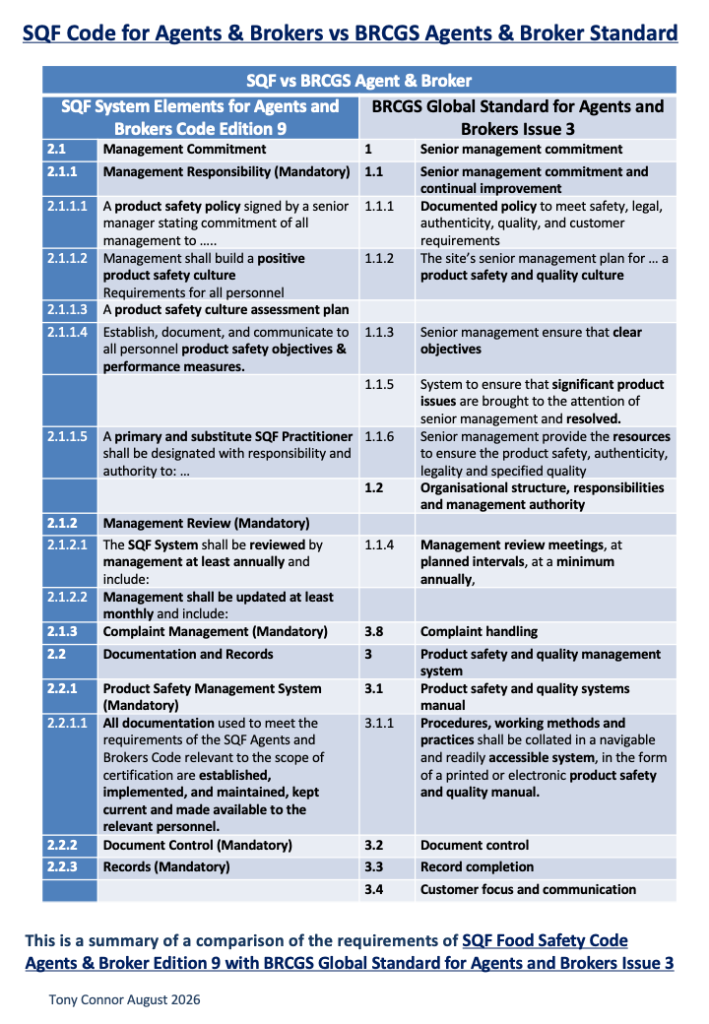
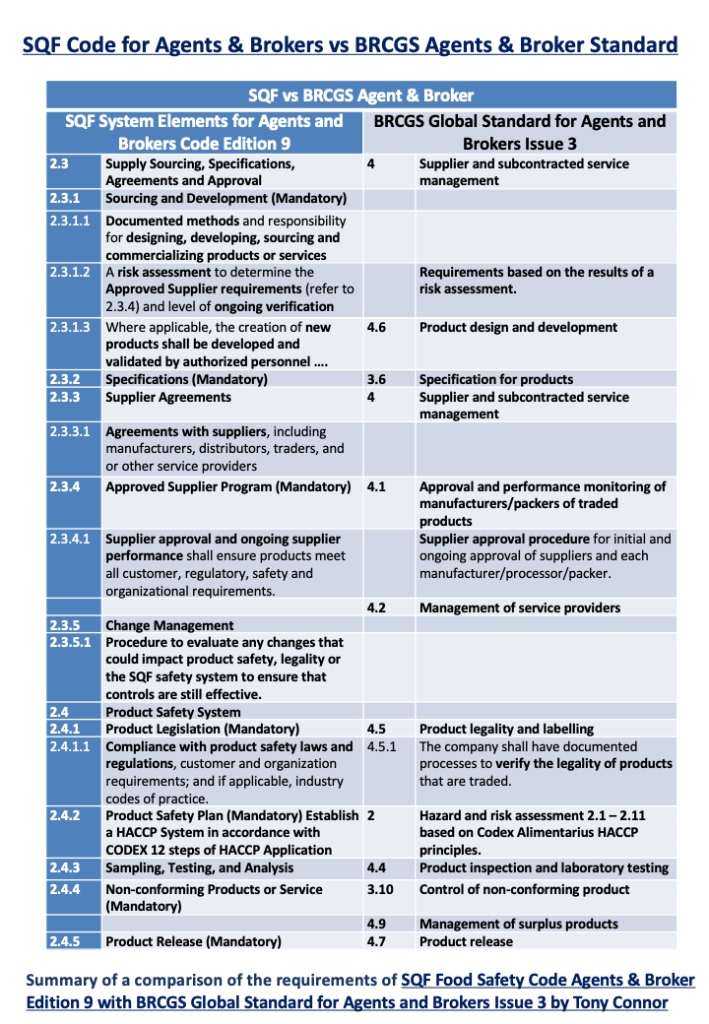
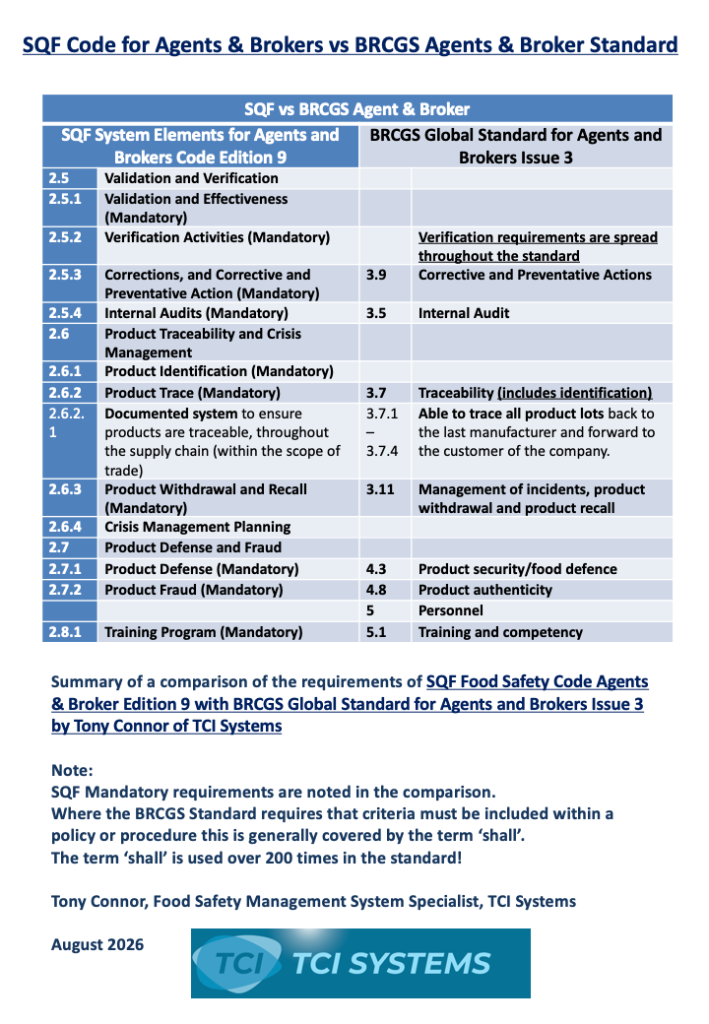
Our graphics here help demonstrate the similarities and differences between the SQF Food Safety Code for Agents and Brokers Edition 9 and the BRCGS Global Standard Agents and Brokers Issue 3
In the first section of requirements, the BRCGS Global Standard Agents and Brokers Issue 3 has Section 1 Senior management commitment has sub-sections of 1.1 Senior management commitment and continual improvement, then 1.2 Organisational structure, responsibilities and management authority whilst the SQF Code: Agents & Brokers has Section 2.1 Management Commitment which has subsections of 2.1.1 Management Responsibility (Mandatory) then 2.1.2 Management Review (Mandatory). Both the BRCGS Standard and the SQF Code have requirements for a documented product safety policy, a product safety culture assessment plan, objectives, communication systems, resources, legal compliance and management review. The BRCGS Global Standard Agents and Brokers Issue 3 is more prescriptive in organisational structure, responsibilities and authority requirements.
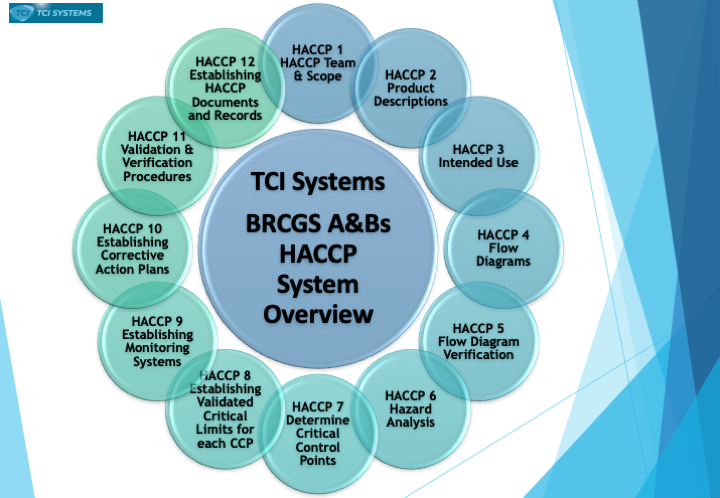
Section 2 of the BRCGS standard requires a Hazard and risk assessment based on Codex Alimentarius HACCP principles, these requirements are described in sub-sections 2.1 – 2.11. These requirements are similar in the SQF Code but in section 2.4 Product Safety System sub-section 2.4.2 Product Safety Plan (Mandatory).
Comparing the BRCGS Global Standard for Agents and Brokers with the SQF Code: Agents & Brokers continued
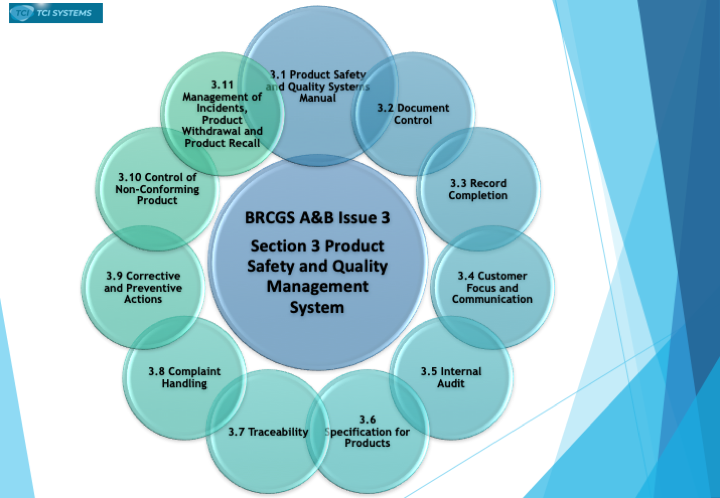
Section 3 of the BRCGS A&B standard is Product Safety and Quality Management System which includes requirements for a Product Safety and Quality Systems Manual, Document Control, Record Completion, Customer Focus and Communication, Internal Audit, Specification for Products, Traceability, Complaint Handling, Corrective and Preventive Actions, Control of Non-Conforming Product, and Management of Incidents, Product Withdrawal and Product Recall. The SQF Code: Agents & Brokers has similar requirements in the following sections/sub-sections: 2.2 Documentation and Records, 2.2.1 Product Safety Management System (Mandatory), 2.2.2 Document Control (Mandatory), 2.2.3 Records (Mandatory), 2.5.4 Internal Audits (Mandatory), 2.3.2 Specifications (Mandatory), 2.6.1 Product Identification (Mandatory), 2.6.2 Product Trace (Mandatory), 2.1.3 Complaint Management (Mandatory), 2.5.3 Corrections, and Corrective and Preventative Action (Mandatory), 2.4.4 Non-conforming Products or Service (Mandatory), 2.6.3 Product Withdrawal and Recall (Mandatory), and 2.6.4 Crisis Management Planning.
The SQF Code for A&Bs stipulates Specific Records that are required as applicable in Clauses 2.2.3.3 – 2.2.3.5, the BRCGS standard does refer to record requirements throughout the standard and also has 3.3 Record completion statement of intent ‘The company shall maintain genuine records to demonstrate the effective control of product safety, authenticity, legality, and quality’. There is also the new SQF sub-section for 2.3.5 Change Management which requires ‘a procedure to evaluate any changes, including temporary, emergency, unplanned, or those made as a result of the corrective action process, that could impact product safety, legality or the SQF safety system to ensure that controls are still effective.’ Control of changes are mentioned throughout the BRCGS A&B standard and in sub-section 4.6 Product Design and Development.
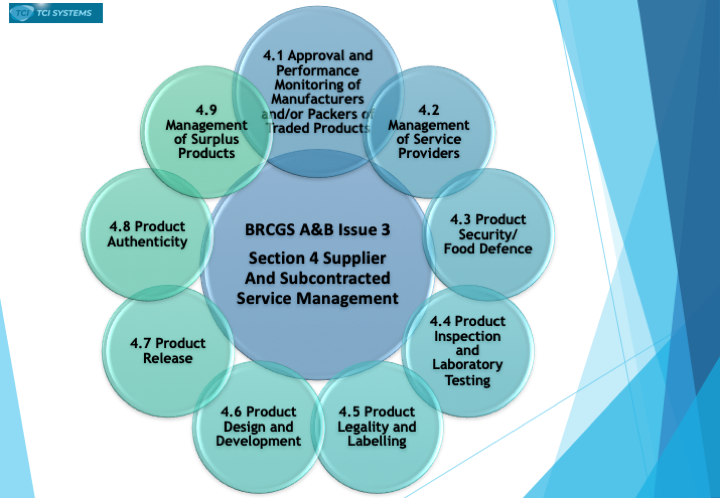
Section 4 of the BRCGS A&B standard is Supplier and Subcontracted Service Management which includes requirements for a Approval and performance monitoring of manufacturers/packers of traded products, Management of service providers, Product security/food defence, Product inspection and laboratory testing, Product legality and labelling, Product design and development, Product release, Product authenticity, and Management of surplus products.
The SQF Code for A&Bs has similar requirements in the following sections/sub-sections: 2.3 Supply Sourcing, Specifications, Agreements and Approval, 2.3.1 Sourcing and Development (Mandatory), 2.3.3 Supplier Agreements, 2.3.4 Approved Supplier Program (Mandatory), 2.7.1 Product Defense (Mandatory), 2.4.3 Sampling, Testing, and Analysis, 2.4.1 Product Legislation (Mandatory), 2.3.5 Change Management, 2.4.5 Product Release (Mandatory), and 2.7.2 Product Fraud (Mandatory).
Both the BRCGS A&B standard and SQF Code for A&Bs also have requirements for Validation and Verification Activities.
Section 5 Personnel is the final section of the BRCGS A&B standard which includes requirements for Training and competency. There are similar requirements in the SQF Code: Agent and Brokers sub-section 2.8.1 Training Program (Mandatory).
Which Certification Scheme to use the BRCGS Global Standard for Agents and Brokers or the SQF Code: Agents & Brokers ?
In making your decision you should consider whether you want an established GFSI benchmarked standard, in that case BRCGS Global Standard Agents and Brokers Issue 3 would be the certification standard to choose. If that is of less importance to you and cost is a factor, certification to the SQF Code: Agents and Brokers, Edition 9 may be of better value and can be completed remotely.
Get BRCGS Agents and Brokers Certification
The easiest way to get BRCGS Agents and Brokers certification is to use our BRC Agents & Brokers Product Safety & Quality Management System Implementation Package (Issue 3). This package has a Comprehensive Procedures Manual covering all sections of the BRCGS Agents and Brokers standard for ease of implementation:
- Senior Management Commitment and Continual Improvement
- Hazard and Risk Assessment
- Product Safety and Quality Management System
- Supplier and Subcontracted Service Management
- Personnel
The package also includes additional tools and templates plus online technical support from our BRCGS Consultants until you achieve certification.
About the Author - Tony Connor Bio
After gaining an Honors Degree in Molecular Biology and Biochemistry at the highly-rated Durham University, Tony Connor embarked on a highly successful career in the food industry.
Tony was appointed Laboratory Manager in 1989, Technical Manager of the UK’s largest multi-product dairy facility in 1993 and qualified as a Lead Assessor in 1994.
Over the years, Tony has gained experience in a variety of roles in the Food Industry including leading roles in Processing, Production, Operations, Quality, New Product Development and Technical departments.
During his career, he has commissioned both new sites and brought old sites up to GFSI benchmarked food safety certification standards, also helping over 2,000 clients gain food safety certification.
With over 35 years’ experience in the food industry, Tony is a highly-regarded food safety expert and provides food operators both food certification services and hygiene, HACCP and Auditor training.
Standard for auditing persons and/or companies who may, or may not own the products, and typically do not take physical possession of the products (e.g. which do not have warehouses, packing stations or truck fleet), but are legal entities which provide broker or agent services.
The Standard applies to food, household and personal care products, as well as packaging materials.
The main objective of the IFS Broker Standard is to ensure broker services compliance and to check how brokers, trading agencies and importers select their suppliers/products, what quality/product safety requirements they have implemented and if they are able to fulfill current legal requirements.
PART 2 includes the IFS Audit Requirements and has the following sections:
1 Senior Management Responsibility
2 Quality and Product Safety Management System
3 Resource Management
4 Planning and Services Process
5 Measurements, Analyses, Improvements
6 Product defense assessment
Standard: Freshcare Supply Chain Standard Edition 2 – July 2021 Scope: FII Food Broker / Agent
The Freshcare Supply Chain Standard Edition 2 (SC2) is an industry owned standard. It is based on the Codex Alimentarius Recommended International Codes of Practice –
General Principles of Food Hygiene CXC 1-1969, Revised 2020, which includes Good Hygiene Practices and the Hazard Analysis and Critical Control Point (HACCP) System.
These are used within a business to provide assurance that fresh produce is safe to eat and has been prepared to meet customer requirements. The SC2 standard is underpinned by the Freshcare Master HACCP Plan.
The Standard identifies good handling practices required to:
Identify and assess the risk of food safety hazards that may occur during the receipt, preparation and handling (including any treatment), packing, storage and distribution of fresh produce
Prevent or minimise the risk of food safety hazards occurring
Foster a culture of best practice food safety and quality
Prepare product to customer specifications
Identify, trace and withdraw/recall product
Manage staff and documentation
Review compliance.