
Free FSSC 22000 Document Guidance: Documents required by the FSSC 22000 Certification Scheme Version 7 for Food Manufacturers
Documents required by the FSSC 22000 Certification Scheme Version 7 for Food Manufacturers
This article describes the documentation you need to achieve FSSC 22000 Certification.
The core requirements of the FSSC 22000 Certification Scheme for Food Manufacturers are, ISO 22000:2018 Food safety management systems – Requirements for any organization in the food chain, ISO 22002-100:2025 Prerequisite programmes on Food Safety Part 100: Requirements for the food, feed and packaging supply chain, ISO 22002-1:2025 Prerequisite Programmes on Food Safety Part 1: Food Manufacturing and the FSSC 22000 Certification Scheme Additional Requirements Version 7.
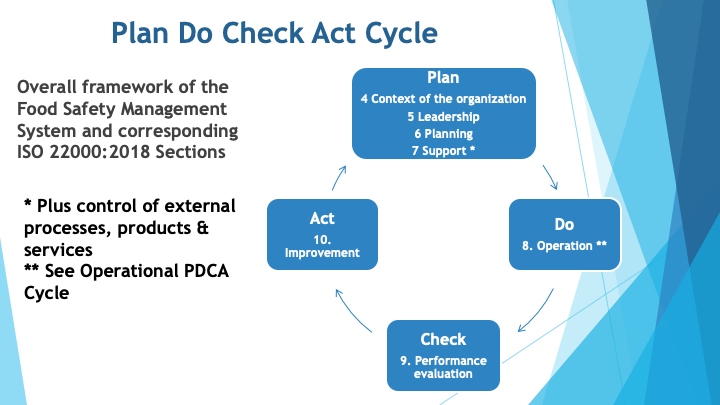
ISO 22000:2018 Food safety management systems – Requirements for any organization in the food chain are in prescribed in sections 4 to 10 of the standard as the above graphic illustrates.
In order to comply with this FSSC 22000 Certification Scheme Version 7 Food Manufacturers require extensive documentation covering key areas of the scheme. Below we outline these key areas.
Implementation Plan
Top Management need to establish the foundations for the Food Safety Management System. The easiest way to do this is to develop an Implementation Plan which enables the organisation to:
- Determine external and internal issues that are relevant and affect its ability to achieve the intended result(s) of its FSMS
- Determine the interested parties (Customer, Regulatory, Statutory and other) that are relevant to the FSMS
- Determine Customer, Regulatory, Statutory and other relevant Food Safety & Quality requirements
- Define the scope and boundaries of the Food Safety & Quality Management System
- Development, implementation and monitoring of a Food Safety & Quality Culture Plan
- Develop a Food Safety & Quality Policy
- Based on the Food Safety & Quality Policy establish Food Safety & Quality Objectives
- Plan the establishment of the FSMS using the project planner
- Provide adequate support to establish the FSMS
- Ensure there is adequate infrastructure and work environment
- Allocate responsibility and authority
- Assess, plan and establish appropriate internal and external communication (including the food chain) channels
Food Safety Management System Procedures
Food Safety Management System Procedures that are compliant with International Standard ISO 22000:2018 Food safety management systems – Requirements for any organization in the food chain and FSSC 22000 Certification Scheme Additional Requirements Version 7 are required. These include:
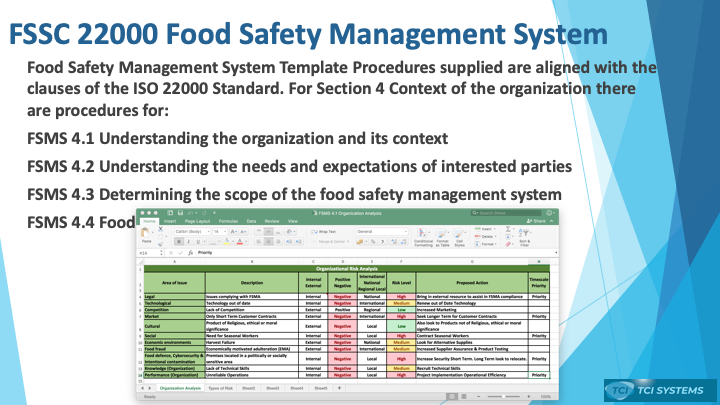
4 Context of the organization: Documenting the context of organization and its context and the needs and expectations of interested parties, determining the scope and establishing a Food Safety & Quality Management System.
5 Leadership: Leadership and commitment requirements are established and documented in the Implementation Plan, Food Safety & Quality Culture Plans and Policies need to be documented. Organizational roles, responsibilities and authorities can be documented in Organizational charts, job descriptions, procedures and work instructions.
6 Planning: The Implementation Plan needs to be followed up with documented actions to address risks and opportunities, food safety & quality objectives that need to be cascaded throughout the organisation and systems to plan and manage changes.
7 Support: Following on from Implementation Plan the Top management need to ensure there are adequate Resources in terms of competent informed Personnel, Infrastructure and the Work environment. Documentation that provide evidence of control of externally provided processes, products or services is required. External communication and Internal communication systems need to be put in place.
A Document Control System needs to be in place. Records and Documented information needs to be approved, controlled and updated when necessary.
Prerequisite Programme Procedures
Prerequisite Programme Template Procedures need to be documented as required and compliant with ISO 22000 Clause 8.2 Prerequisite programmes (PRPs), ISO 22002-100:2025 Prerequisite programmes on Food Safety Part 100: Requirements for the food, feed and packaging supply chain, ISO 22002-1:2025 Prerequisite Programmes on Food Safety Part 1: Food Manufacturing and the FSSC 22000 Certification Scheme Additional Requirements Version 7. There needs to be documented standards and where applicable procedures for the following:
Construction and layout of buildings
Design and layout of facilities and workspaces
Utilities
Waste, FLW management and recycling
Equipment suitability and maintenance
Management of purchased materials
Measures for prevention of contamination
Cleaning and disinfection
Pest control
Personal hygiene and employee facilities
Rework
Storage, including warehousing, and transport
Product and consumer information
Food defence and food fraud
8 Operational Documentation
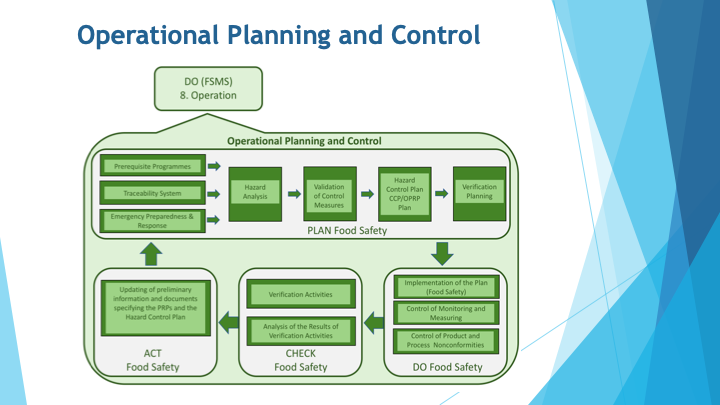
Procedures need to be in place to cover ISO 22000 requirements for Operational planning and control, Product Development Module/Folder, Product Identification and Traceability system, Control of monitoring and measuring, Verification, Control of product and process nonconformities, Corrections & Corrective actions, the Handling of potentially unsafe products, Product Withdrawal/recall and for Emergency preparedness and response.
Hazard Control Plan Procedures
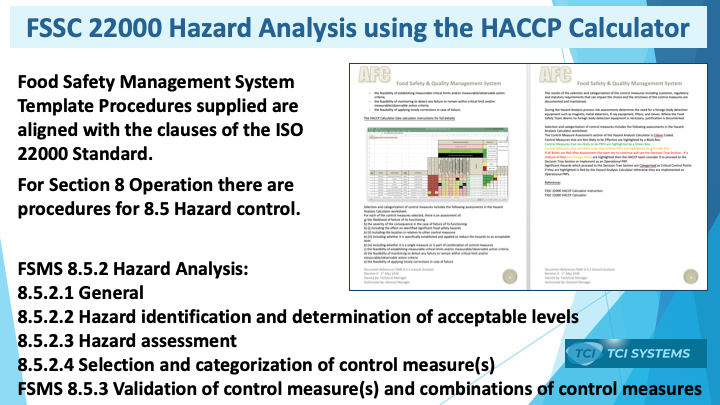
Extensive HACCP System documentation is required to meet the requirements of ISO 22000:2018 and the Twelve HACCP Application Steps prescribed in CODEX General Principles of Food Hygiene 2022 Edition HACCP System and Guidelines for its Application. This includes documents to cover the ISO 22000 Section 8.5 Hazard Control as described below.
ISO 22000 Section 8.5.1 Preliminary steps to enable hazard analysis: Including Characteristics of raw materials, ingredients and product contact materials, Characteristics of end products, Intended use, Flow diagrams, and Descriptions of processes.
ISO 22000 Section 8.5.2 Hazard analysis: Including Hazard identification and determination of acceptable levels, Hazard assessment, Selection and categorization of control measure(s)
ISO 22000 Section 8.5.3 Validation of control measure(s) and combinations of control measures
ISO 22000 Section 8.5.4 Hazard control plan (HACCP/OPRP plan): Including Determination of critical limits and action criteria, Monitoring systems at CCPs and for OPRPs, Actions when critical limits or action criteria are not met, and Implementation of the hazard control plan.
Operational Prerequisite Programme Procedures
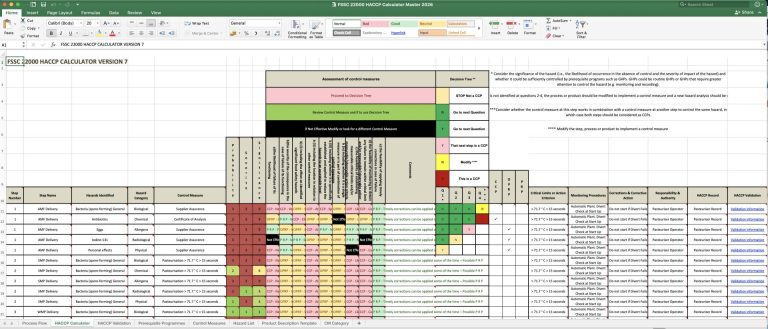
Sections 8.5.2 to 8.5.4 have requirements for Operational Prerequisite Programmes that is not are not found in a traditional HACCP System and unique to ISO 22000 and hence FSSC 22000. In Section 8.5.2.4, Selection and categorization of control measure(s), appropriate control measures need to be identified and the control measure(s) categorized as OPRP(s) or as Critical Control Points (CCPs) using a logic system which considers various aspects including likelihood of failure, severity of the hazard, nature of the control measure and the feasibility of it being effective. These aspects need to be validated to ensure effective control as per Section 8.5.3 Validation of control measure(s) and combinations of control measures. Operational Prerequisite Programmes OPRP(s) and Critical Control Points (CCPs) are then documented in a Hazard control plan (HACCP/OPRP plan) as per clause 8.5.4.
After this there needs to be documented evidence of compliance with section 8.6 Updating the information specifying the PRPs and the hazard control plan.
9 Performance Evaluation
Procedures need to be in place to cover ISO 22000 requirements for 9.1 Monitoring, measurement, analysis and evaluation, 9.2 Internal audit and 9.3 Management review. Note that Inspections are required and it makes sense to tie these in with the Internal Audit Procedure.
10 Improvement
Procedures need to be in place to control Nonconformity, manage Corrective Actions, take measures to Continually Improve and Update the Food Safety & Quality Management System.
2.5 FSSC 22000 Additional Requirements
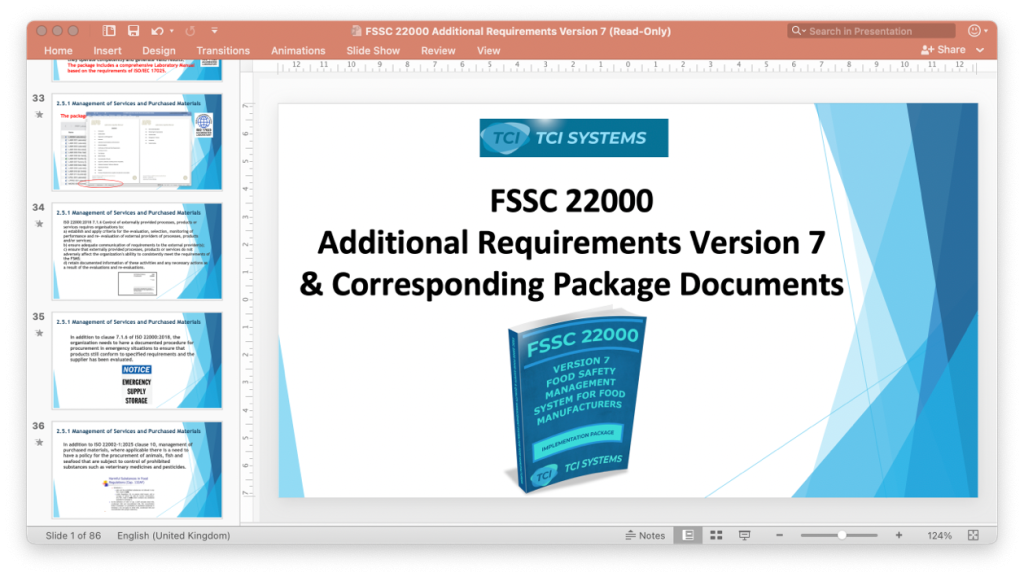
Moving on to the FSSC 22000 Certification Scheme Version 7 Part II: Requirements for Organizations to be Audited, documentation needs to cover additional aspects that are not covered in the ISO 22000/22002 standards but are required by the GFSI benchmark. These include aspects of the following:
2.5.1 Management of Services and Purchased Materials
2.5.2 Product Labelling and Printed Materials
2.5.3 Food Defense
2.5.4 Food Fraud Mitigation
2.5.5 Logo Use
2.5.6 Management of Allergens
2.5.7 Environmental Monitoring
2.5.8 Food Safety and Quality Culture
2.5.9 Quality Control
2.5.10 Transport, Storage and Warehousing
2.5.11 Hazard Control and Measures for Preventing Cross-contamination
2.5.12 PRP Verification
2.5.13 Product Design and Development
2.5.14 Traceability (Food Chain Sub Category C0 only)
2.5.15 Equipment Management
2.5.16 Food Loss and Waste
2.5.17 Communication Requirements
2.5.18 Requirements for Organization with Multi-Site Certification
Key elements requiring documented controls are laboratory standards to ISO/IEC 17025 level, specification requirements, labelling controls, allergen controls, environmental monitoring, food safety culture, quality control, foreign body control, verification via inspections, control of changes, equipment management, and control of food loss and waste.
Origin of the FSSC 22000 Certification Scheme
ISO 22000 Food safety management systems — Requirements for any organization in the food chain which was initially published in 2005 and has never been recognized by GFSI and GFSI recognition is playing an important role in Food Safety Management Systems Certification. To address this in 2009, four leading global food manufacturers joined forces and created the FSSC 22000 scheme. By using the ISO 22000 standard, adding Prerequisite Program requirements based on ISO Technical Specifications/Publicly Available Standards (PAS) and FSSC 22000 additional requirements the Foundation created an ISO 22000 based scheme that is benchmarked and recognized by GFSI.
FSSC 22000 Certification Scheme Version 7 incorporates the new ISO 22002-x:2025 series on pre-requisite programs, aligns the Scheme with the GFSI benchmarking requirements v2024, provides a more defined structure for the division of food chain categories and includes revised Additional Requirements. For more details see FSSC 22000 Version 7: Key Changes Explained on the FSSC website.
About the Author - Tony Connor Bio
After gaining an Honors Degree in Molecular Biology and Biochemistry at the highly-rated Durham University, Tony Connor embarked on a highly successful career in the food industry.
Tony was appointed Laboratory Manager in 1989, Technical Manager of the UK’s largest multi-product dairy facility in 1993 and qualified as a Lead Assessor in 1994.
Over the years, Tony has gained experience in a variety of roles in the Food Industry including leading roles in Processing, Production, Operations, Quality, New Product Development and Technical departments.
During his career, he has commissioned both new sites and brought old sites up to GFSI benchmarked food safety certification standards, also helping over 2,000 clients gain food safety certification.
With over 35 years’ experience in the food industry, Tony is a highly-regarded food safety expert and provides food operators both food certification services and hygiene, HACCP and Auditor training.