
Salmonella Contamination in Iranian Pistachios causes Product Recall Chaos
At the start of this year I analyzed Major Food Safety Product Recall statistics from 2025 for the United States (FSIS & FDA), Canada, United Kingdom, Australia and New Zealand. My analysis found familiar reasons for the recalls, from a total of 872 recalls 42.66% were due to Undeclared Allergen 19.61% were due to Salmonella Contamination and 10.55% due to Listeria monocytogenes Contamination.
Whilst it isn’t unusual for these big three to account for over 75% of all product recalls what did stick out like a sore thumb was the proportionally higher number of Salmonella Recalls in Canada in 2025. Looking at individual recalls I found that nearly all these recalls were due to Salmonella in Pistachios and Pistachio-containing Products.

Canada Product Recall Statistics 2025
Analysis of a total of 268 Canada CFIA published product recalls in 2025 had Salmonella Contamination as the leading cause of recalls at 42.91%, then there was Undeclared Allergen at 29.10%, then recalls due to Foreign Body Contamination at 12.69%.
Recalls due to Listeria monocytogenes were at 4.48% and appear to reflect the good work the Canadian Authorities have put in to reducing the risks of Listeria Contamination following the 2008 Canadian Listeriosis Outbreak.
This percentage of product recalls due to Salmonella Contamination is not typical of my statistical analysis of recalls going back over a decade.

Huge Number of Product Recalls due to Salmonella Contamination
Further analysis highlighted that nearly every product recall due to Salmonella Contamination was for Pistachios and Pistachio-containing Products and that the contaminated products were traced to pistachios imported from Iran. On 27 September 2025, the Canadian Food Inspection Agency implemented a temporary import ban on pistachios and pistachio-containing products from Iran, along with mandatory hold-and-test requirements for previously imported stock. Also, beginning November 12, 2025, Food Recall Warnings and Notifications linked to the CFIA’s food safety investigation into pistachios and pistachio-containing products were published in one recall warning. My original Canada recall figures did not include the now grouped Pistachio recalls, if I include all the individual extra group recall notices – Salmonella ends up at roughly 75% (Salmonella 74.7% Undeclared Allergen 12.9% and Listeria monocytogenes 2%). This demonstrates the extent of this issue, this Salmonella outbreak began in mid-March 2025 and has continued through January 2026.
Salmonella Contamination in Pistachios is High-Risk
Twelve Salmonella serotypes have been identified in this outbreak. The presence of multiple Salmonella serotypes indicates widespread environmental contamination during pistachio cultivation, harvest, or processing. Certain serotypes, such as S. Havana, can survive in soil, consistent with contamination from manure runoff, sewage exposure, or wildlife contact in the growing areas.
The survival of Salmonella in low-moisture, high-fat foods such as nuts and chocolate may increase the risk of severe infection for several reasons, including protection of the bacteria from stomach acid. This could help explain the 15% hospitalization rate, which is higher than usual for salmonellosis. Pistachios’ low moisture and high fat content protect Salmonella from stomach acid, increasing infection risk.

Dry heat is not a reliable control for this hazard
This resistance is emphasized in Canada Government Notices: ‘If you package pistachios or use pistachios as an ingredient to make another food, do not rely on dry heat, such as roasting, to eliminate Salmonella from pistachio products from Iran. Although heat usually destroys bacteria, Salmonella can survive in high-fat, low moisture foods such as pistachios. Dry heat is not a reliable control for this hazard. Throughout the outbreak, dry heat treatments have failed to eliminate Salmonella in prepared products.’
The top areas for growing pistachios are: United States (California): The biggest producer in the world, 54% of all pistachios in 2022/23, Iran: A traditional leader in pistachio production, contributing 27% of the global supply, known for its strong flavor, Turkey: In third place, Turkey accounts for 13% of the world’s pistachio supply.
'There is no safe level of Salmonella'
As demonstrated in this outbreak, for Salmonella spp., the infectious dose is thought to be very low, as demonstrated by the small numbers of cells per serving recovered from low-moisture foods implicated in outbreaks. Furthermore, there is evidence that the composition of a food (especially, high fat content) may protect Salmonella against the acidic conditions of the stomach, potentially increasing the likelihood of illness from consuming low numbers of the organism. After the 2006 Cadburys Salmonella outbreak Bacteriologist Professor Hugh Pennington of Aberdeen University stated that the only safe level of salmonella in chocolate was “zero”.
Examples of Pathogens Identified from Outbreaks Attributed to Contamination with Environmental Pathogens also include Salmonella in Chocolate, Peanut Butter and White Pepper.
Environmental Monitoring: It is important that all sites have Risk-based environmental monitoring program for the relevant pathogens, spoilage, and indicator organisms; swabbing locations and methods need to be clearly defined and documented and the program needs be reviewed for continued effectiveness, at least annually, and when there are significant changes
On a final note regarding Salmonella contamination, I leave you with this Canadian Government Advice: Source Pistachios only from trusted suppliers who provide clear evidence that Salmonella is not present in their Pistachio Product(s).
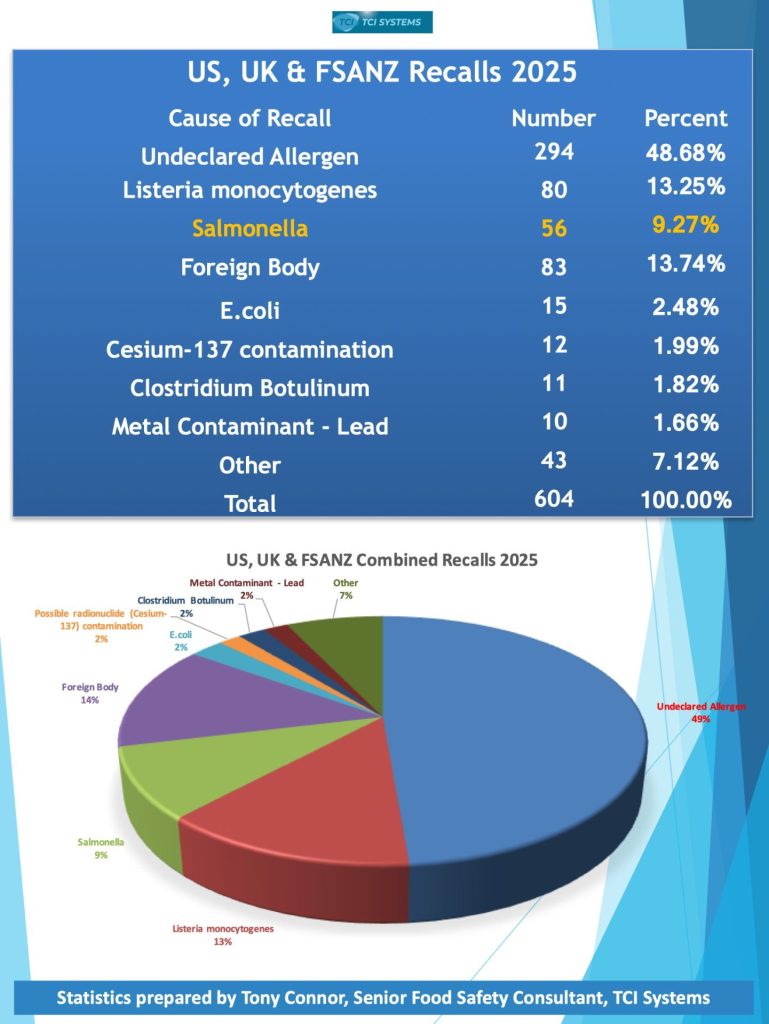
Adjusted 2025 Product Recall Figures
As the Canada recalls skew the figures, here is a summary without them. This gives us a Combined Recall Analysis 2025 total of 604 Product Recalls. The Causes of the Product Recalls: Undeclared Allergen 48.68%, Foreign Body 13.74%, Listeria monocytogenes 13.25%, Salmonella 9.27%, E.coli 2.48%, Cesium-137 contamination 1.99%, Clostridium Botulinum 1.82%, Metal Contaminant – Lead 1.66% and the Other Reasons for Product Recall 7.12%.
Removing the Canada Salmonella bias means that just over 71% of Product Recalls from United States, United Kingdom, Australia and New Zealand combined were due Undeclared Allergens/Labelling or by product contamination Salmonella or Listeria.
With and without Canada Data, Product Recalls due to a variety of Foreign Objects account for over 13% of all Recalls.
TCI SYSTEMS
TCI SYSTEMS Heading 3
We are an international supplier of quality management and food safety management systems. We have helped companies and organisations worldwide to achieve the certification of their choice. Our packages have been specifically written to provide a systematic approach to gaining certification.
We are an international heading 5
We have over 20 years experience in food safety and quality management. Our experts have been in the business since the early 1990’s. Their management roles have included laboratory manager, production manager, quality assurance manager, technical and processing manager, technical manager, technical and development manager and group technical manager.
So you can see we have a broad knowledge of departments that operate within a company which is highly valuable when documenting policies and procedures relating to those activities. We also have our own in-house qualified quality management system auditor involved in the creation of these systems. This means that we know exactly what you need to do to meet the requirements of these standards.
Our premium packages include unlimited email support throughout the whole certification process. You will essentially have your very own expert on call for a fraction of the price of an onsite consultant.
About the Author - Tony Connor Bio
After gaining an Honors Degree in Molecular Biology and Biochemistry at the highly-rated Durham University, Tony Connor embarked on a highly successful career in the food industry.
Tony was appointed Laboratory Manager in 1989, Technical Manager of the UK’s largest multi-product dairy facility in 1993 and qualified as a Lead Assessor in 1994.
Over the years, Tony has gained experience in a variety of roles in the Food Industry including leading roles in Processing, Production, Operations, Quality, New Product Development and Technical departments.
During his career, he has commissioned both new sites and brought old sites up to SQF certification standard, helping many SQF Practitioners achieve SQF food safety certification for their organization.
With over 35 years’ experience in the food industry, Tony is a highly-regarded food safety expert and provides food operators both food certification services and hygiene, HACCP and Auditor training.