
How to Develop a Food Safety Culture
Food Safety Culture
By Tony Connor
A successful food safety culture is the product of individual and group values, attitudes, competencies and patterns of behaviour that determine the commitment to, and the style and proficiency of the food safety management system. Senior management should plan for the development and continuing improvement of a food safety culture.
What is Food Safety Culture?
Food safety culture refers to the shared values, beliefs, and norms that affect the mindset and behavior toward food safety in, across, and throughout an organization.
Unlike a formal management system (like HACCP), which focuses on processes, culture focuses on people. It is not just about what employees do when the auditor is watching, but what they do when no one is looking.
The 4 Pillars of Food Safety Culture
To measure and improve culture, major standards like BRCGS and SQF break it down into four distinct dimensions.
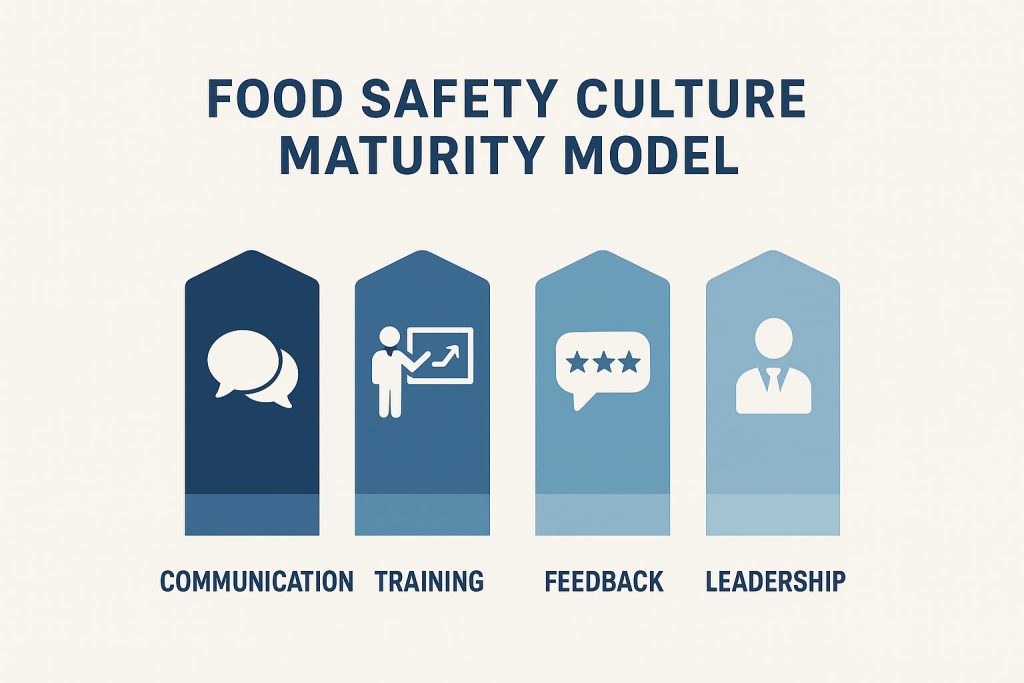
Communication: How freely food safety concerns are discussed.
Training: Ensuring competence, not just attendance.
Feedback: Listening to staff on the floor.
Leadership: Commitment from senior management to prioritize safety over production speed.
Developing a robust plan requires addressing all four of these pillars to move your organization from a “Reactive” maturity level to a “Proactive” one.
Senior management should be implementing a “It is how we do things here” food safety culture. This can be achieved by:
- Leadership – starting from the top
- Demonstrating visible commitment
- Effective communication of company philosophy and policy
- Ensuring there is accountability from the top of the organization to the bottom
- Developing employee confidence and mutual trust
- Developing reward schemes including ‘Employee of the Month’ award
- Ensuring all employees are accountable, engaged and understand the value of integrity and proactivity
- Developing an action plan for the development and continuing improvement of food safety culture
To ensure success Senior Management should be directly responsible for food safety by ensuring adequate; organization and support, equipment and facilities, training and education of all employees, reviewing and auditing performance, and driving continuous improvement.
All employees should be empowered and individually responsible for the quality of their work, resulting in a continual improvement culture and working environment for all. Employees should be encouraged and required to notify management about actual or potential food safety issues and are empowered to act to resolve food safety issues within their scope of work.
The philosophy of Food Safety should be promoted throughout the organization and in particular the Food Safety Policy.
Communication processes for promoting food safety include:
- Team briefings
- Staff reviews
- Daily Management meetings
- Feedback mechanisms
- Newsletters
- Notice boards
Senior management should monitor and measure through reports and trend analysis the degree of development of the food safety culture by analyzing information including KPIs from:
- Hygiene & Housekeeping Audits
- Internal Audits
- External Audits
- Non-conforming products
- Environmental monitoring
- Review of implementation plan and numbers trained
- Employee reviews
- Staff surveys on values and culture
- Customer Complaints
- Staff Turnover
- Staff Exit Interviews
All employees should undergo individual food safety culture development which can include:
- Food Safety Policy
- Food Safety Objectives
- Food Safety Management System Overview
- Job Descriptions
- Job Training
- Employee Briefing
- Individual Objectives
- CCP Controls – Training Procedures & Record Completion
- PRP Controls – Training Procedures & Record Completion
- Employee Review
A training matrix can be used for Food Safety Culture Planning:

Records of all training should be maintained, including those of induction, on-the-job, refresher and external training. Training schedules and records should be managed by Department Managers and where applicable include the following records:
- Training register
- Operator training review
- Training matrix
- Department training matrix
- Individual Training records including:
- Description of training
- Skills description
- Name of trainee
- Confirmation of training
- Date and duration of training
- Trainer details
- Verification that the trainer has assessed the trainee and found them to be competent
- Identifying the competencies needed for specific roles
- Reviewing and auditing the implementation and effectiveness of the training and the competency of the trainer with a view to taking action to improve the training.
About the Author - Tony Connor Bio
After gaining an Honors Degree in Molecular Biology and Biochemistry at the highly-rated Durham University, Tony Connor embarked on a highly successful career in the food industry.
Tony was appointed Laboratory Manager in 1989, Technical Manager of the UK’s largest multi-product dairy facility in 1993 and qualified as a Lead Assessor in 1994.
Over the years, Tony has gained experience in a variety of roles in the Food Industry including leading roles in Processing, Production, Operations, Quality, New Product Development and Technical departments.
During his career, he has commissioned both new sites and brought old sites up to GFSI benchmarked food safety certification standards, also helping over 2,000 clients gain food safety certification.
With over 35 years’ experience in the food industry, Tony is a highly-regarded food safety expert and provides food operators both food certification services and hygiene, HACCP and Auditor training.