
Common Food Safety Hazards – Parasites
Welcome to our latest article in our series of blogs providing advice on how to prepare for a food safety audit.
This is the second of 3 blogs on Common Food Safety Hazards.
In this article, we discuss control of the most common Parasites associated with food which are:
Cryptosporidium parvum
Cyclospora cayetanensis
Giardia duodenalis
Toxoplasma gondii
Trichinella spiralis
By Tony Connor

Identifying Hazards is an important part of developing your HACCP System. The information here assists with Principle 1 requirement to Conduct a hazard analysis and identify potential hazards. See our article HACCP 7 principles explained – How to implement a HACCP System based on new CODEX HACCP Principles and Decision Tree for more details.
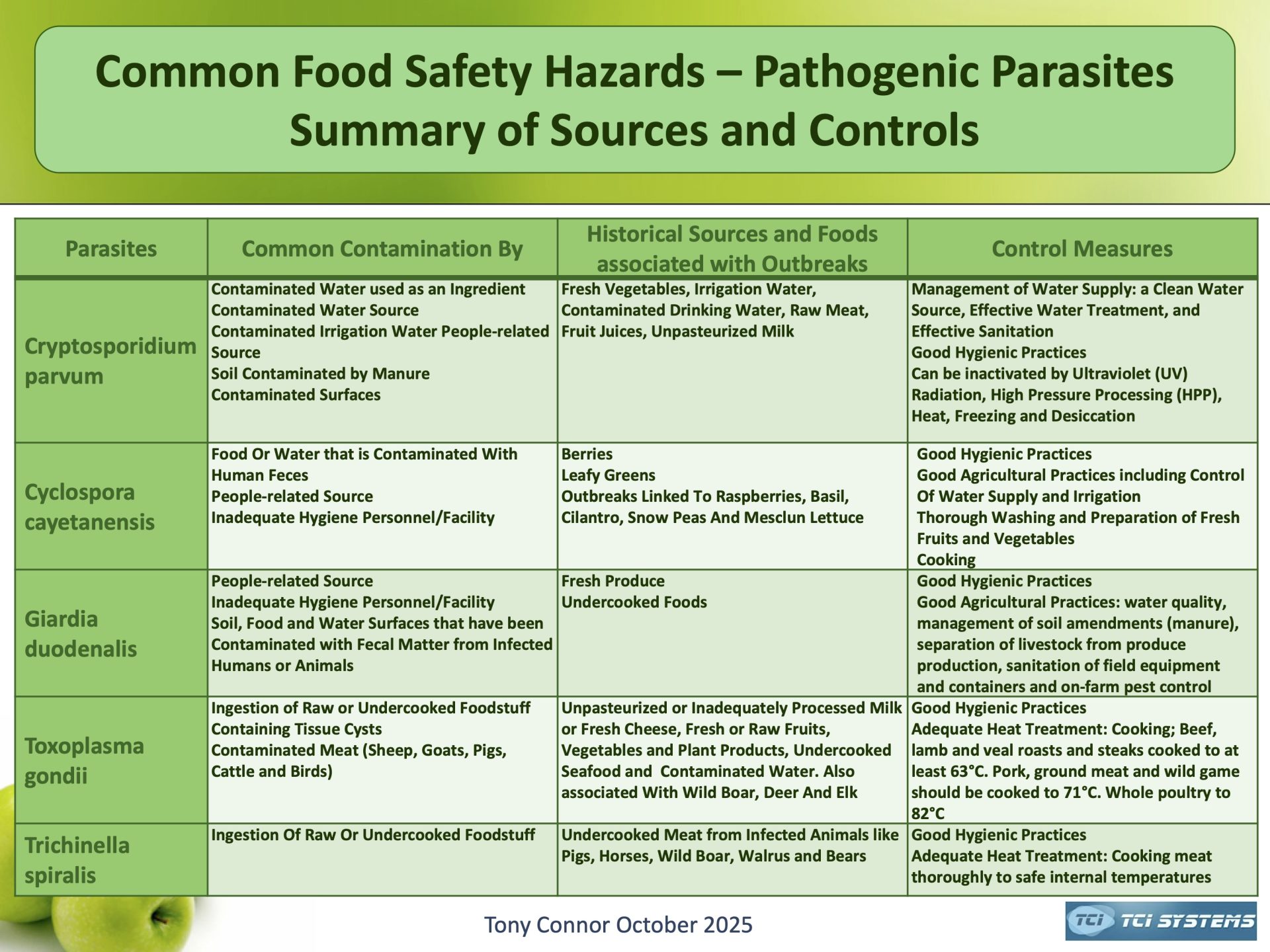
The Main Parasites associated with Food, Sources and Control Measures are summarized below
Cryptosporidium parvum
Cryptosporidiosis is a disease caused by the microscopic parasite Cryptosporidium which is an obligate parasite and must have a host to complete its lifecycle. This parasite can live in water, food, soil, or on surfaces that have been contaminated with infected feces and causes watery diarrhea.
Surface waters are more vulnerable to direct contamination from: fertilizer, manure, sewage, industrial discharges, and runoff. Farmyard manure may contain high numbers of Cryptosporidium oocysts and vegetable crops may be contaminated by direct manuring of the fields in which they are grown. The majority of water treatment plants cannot completely guarantee removal of all Cryptosporidium oocysts from the water, since they are very small and resistant to chlorine.
Cryptosporidium parvum infections can be caused by contamination of food by individuals who are infected or carriers, by contaminated water used as an ingredient and a contaminated water source. Cryptosporidium has been isolated from: fresh vegetables, irrigation water, contaminated drinking water, raw meat, fruit juices, unpasteurized milk and swimming pools.
Cryptosporidium is inactivated by ultraviolet radiation (UV), heat, freezing and desiccation, hence heat-treated, frozen and dried foods should be safe, unless contaminated after processing. Control measures included strict hygiene, using a clean water source, effective water treatment, and effective sanitation, since it is highly resistant to chlorine.
High Pressure Processing (HPP) has been used to kill Cryptosporidium oocysts when treated by HPP in apple and orange juice
Cyclospora cayetanensis
Cyclospora is a foodborne hazard that is a microscopic parasite causing an intestinal illness called cyclosporiasis. Cyclospora infects the small intestine (bowel) and usually causes watery diarrhea, with frequent, sometimes explosive, bowel movements.
The Cyclospora life cycle involves ingestion of sporulated oocysts, which exist in the host’s small intestine, invade epithelial cells, and reproduce to form new unsporulated oocysts. These unsporulated oocysts are then excreted in feces and require several weeks to sporulate and become infectious in the environment which means that person to person infections are not a form of transmission.
Cyclospora is transmitted when food or water is contaminated with human feces, with fresh produce like berries and leafy greens being common sources. It’s unlikely to be transmitted directly from person to person because the Cyclospora parasite needs time (days to weeks) after being passed in a bowel movement to become infectious for another person.
Past outbreaks have been linked to raspberries, basil, cilantro, snow peas and mesclun lettuce.
The Cyclospora cayetanensis parasite is a reasonably foreseeable biological hazard; in berries and berry-containing products that have not been heat treated sufficiently to inactivate Cyclospora, and fresh herbs (such as basil and cilantro) and uncooked foods containing these herbs, but could also apply to other produce from areas where Cyclospora has been determined to be present such as in the water supply.
Cyclospora is known to be at least somewhat resistant to freezing because an outbreak occurred attributed to raspberries in cake that was previously frozen at about 26°F (–3.3° C)
Good agricultural practices, good hygienic practices, thorough washing and preparation of fresh fruits and vegetables, control of water supply and irrigation and cooking are appropriate measures to control Cyclospora.
Giardia duodenalis
Giardiasis is a parasitic disease caused by ingestion of Giardia duodenalis (also known as Giardia intestinalis and Giardia lamblia) cysts by fecal-oral route and is especially common in children and travelers. The parasite can be found in soil, food and water surfaces that have been contaminated with fecal matter from infected humans or animals.
Giardia duodenalis requires a human or animal host in order to reproduce. Infected individuals experience watery diarrhea; abdominal pain, weight loss, and weakness due to dehydration and malabsorption. Symptoms usually begin one to three weeks after exposure. Primary routes are personal contact, contaminated water and food.
Person-to-person transmission accounts for the majority of Giardia infections and is usually associated with poor hygiene and sanitation. Giardia is often found on the surface of the ground, in the soil, in undercooked foods, and in water, and on hands that have not been properly cleaned after handling infected feces.
Contamination of fresh produce can occur by contaminated irrigation water, contaminated flood water or water used for postharvest washing of produce.
The parasite can be passed on by infected workers, run-off from manure, wild animals passing through or grazing in production fields and flies that spread cysts
Prevention may be improved through proper personal hygiene practices and by cooking and sanitizing food
Control Measures include monitoring water quality, good hygienic practices, management of soil amendments (such as manure), separation of livestock from produce production, sanitation of field equipment and containers and on-farm pest control.
Toxoplasma gondii
Toxoplasmosis is an infection caused by Toxoplasma gondii usually caused by ingestion of water contaminated with oocysts from the feces of infected cats or by the ingestion of raw or undercooked foodstuff containing tissue cysts. Most people do not get symptoms when infected, when they do the infection typically causes flu-like symptoms, swollen lymph nodes, muscle aches, and pains but can be more severe.
Toxoplasma gondii can directly or indirectly cause infections in humans consuming high risk food products such as contaminated meat (sheep, goats, pigs, cattle and birds), unpasteurized or inadequately processed milk or fresh cheese, fresh or raw fruits, vegetables and plant products, undercooked seafood as well as contaminated water.
The Toxoplasma gondii parasite has also been as associated with wild boar, deer and elk.
Infection may also occur by consumption of raw or undercooked meat containing the cysts or exposure to cross-contamination through water and food contaminated with feline feces. Up to 63% of infections have been found to be attributed to raw and undercooked meat consumption.
The most effective control measure is Cooking; Beef, lamb and veal roasts and steaks should be cooked to at least 63°C. Pork, ground meat and wild game should be cooked to 71°C before eating. Whole poultry should be cooked to 82°C in the thigh to ensure doneness.
Freezing for two days at −20°C has been shown to be sufficient to inactivate the parasite
Also, some studies have shown that cysts of T. gondii are killed during salt curing, the inactivation of cysts is dependent on the maturation time, temperature of storage and salt concentration in the curing process. Good hygiene practices during food handling, production and processing are also required to prevent contamination of food.
Trichinella spiralis
Trichinella is a parasitic worm that can cause a food-borne illness called trichinellosis when people eat raw or undercooked meat from infected animals like pigs, horses, wild boar, walrus and bears that contain the parasite’s larvae, it is primarily a problem with wild game such as wild boar, bear and walrus Initial symptoms include nausea, diarrhea, and abdominal discomfort, while later symptoms that develop a few weeks after infection can include fever, muscle aches, and swelling around the eyes.
The infection can be prevented by cooking meat thoroughly to safe internal temperatures and washing hands after handling raw meat.
Adequate cooking is a widely-accepted method of destroying the Trichinella parasite but other methods have been considered, Ionizing Radiation has been used for the control of Trichinella spiralis in pork carcasses or fresh, non-heat-processed cuts of pork carcasses. High Pressure Processing (HPP) has also been shown to be capable of eliminating parasitic worms of Trichinella spiralis. Freezing can kill Trichinella spiralis in domestic pork with specific time and temperature combinations, freezing meat less than 6 inches thick for 20 days at 5゚F -15゚C has been shown to be effective. Wild game requires different, more stringent methods, and freezing alone is often not sufficient to guarantee safety due to the presence of cold-resistant species like T. nativa and T. britovi. Cooking wild game meat to a core temperature of at least 71°C is recommended by ICT.
About the Author - Tony Connor Bio
After gaining an Honors Degree in Molecular Biology and Biochemistry at the highly-rated Durham University, Tony Connor embarked on a highly successful career in the food industry.
Tony was appointed Laboratory Manager in 1989, Technical Manager of the UK’s largest multi-product dairy facility in 1993 and qualified as a Lead Assessor in 1994.
Over the years, Tony has gained experience in a variety of roles in the Food Industry including leading roles in Processing, Production, Operations, Quality, New Product Development and Technical departments.
During his career, he has commissioned both new sites and brought old sites up to GFSI benchmarked food safety certification standards, also helping over 2,000 clients gain food safety certification.
With over 35 years’ experience in the food industry, Tony is a highly-regarded food safety expert and provides food operators both food certification services and hygiene, HACCP and Auditor training.