
Key Changes in SQF Edition 10 of the Food Safety Code
The SQFI has just released SQF Edition 10 of the SQF Code, one of the most popular certification standards worldwide. The SQF Food Safety Code is a HACCP based food safety management system certification standard recognized by GFSI (Global Food Safety Initiative). GFSI has recognised SQF as one of the benchmarked schemes that meet their requirements for food safety management systems. GFSI recognition is important to Food Safety Certification Schemes as it means that that companies implementing the SQF Code demonstrate compliance with international food safety standards, giving them credibility with customers and facilitating access to global markets.
‘SQF Food Safety Code Edition 10 is now available, and it marks more than a routine update to the Code. It introduces a fully digitized experience designed to help sites, auditors, and stakeholders navigate requirements with greater clarity and precision.’
Edition 10 reflects extensive industry input and aligns with evolving risk expectations, including measurable food safety culture requirements and a revised scoring model that better weighs systemic controls.
By LeAnn Chuboff, Vice President, Technical Affairs, SQFI
There are food safety and quality Codes for all Food Sector Categories of the food supply chain from primary production through to retail and foodservices. You can use the SQF Code Selector to select the relevant SQF Food Safety Code Edition 10 for your operation/products. Although the SQF Code is a digital version you are still able to get yourself a pdf copy by printing the digital code that you have selected.
Summary of SQF Edition 10 Key Changes
PART B: The SQF Food Safety Code: Food Manufacturing – System Elements Edition 10
2.1.1 Management Responsibility (Mandatory) (Core Clause) Identified as Core Clause
2.1.1.3 New Requirement – A food safety culture assessment plan to drive continuous improvement shall be documented, implemented, and maintained.
2.1.2 Management Review (Mandatory) (Core Clause) Identified as Core Clause
2.1.3 Complaint Management (Mandatory) (Core Clause)
2.2.3.3 New element- combined mandatory annual records.
2.2.3.4 New element- combined records supporting food safety management program.
2.2.3.5 New element- combined records of food safety programs.
2.3.4 Approved Supplier Program (Mandatory) (Core Clause) Identified as Core Clause
2.3.5 New clause – Change Management: The site shall document and implement a procedure to evaluate any changes, including temporary, emergency, unplanned, or those made as a result of the corrective action process, that could impact food safety or the food safety system to ensure that controls are still effective.
2.4.3 Food Safety Plan (Mandatory) (Core Clause) Identified as Core Clause Added the latest version of CODEX to be used
2.4.8 Environmental Monitoring (Core Clause) Identified as Core Clause
2.5.3 Corrections, and Corrective and Preventative Action (Mandatory) (Core Clause) Added corrections to distinguish that they are different. Identified as Core Clause
2.6.1 Product Identification (Mandatory) (Core Clause) Identified as Core Clause
2.8.1 Allergen Management (Mandatory) (Core Clause) Identified as Core Clause
2.9.1.2 NEW element – Some Specific Training needs to include a documented assessment – separated out to include a required assessment.
2.9.1.3 NEW element – Instruction – combining all instruction requirements previously found throughout the code.
PART B: The SQF Food Safety Code: Food Manufacturing – Module 11: Good Manufacturing Practices for Processing of Food Products Edition 10
Considerable renumbering and alignment/movement of requirements
11.1.1 Premises Location and Approval 11.1.1 Risk Assessments Change to include all risk assessments
11.2.5 Cleaning and Sanitation (Core Clause) Identified as Core Clause
11.7.3 Control of Foreign Matter Contamination (Core Clause) Identified as Core Clause
Also Note: Core clauses have been defined and any non-conformances during a certification audit result in a higher points deduction for core clause NCs
Non-conformances against Core Clauses are weighted more heavily in the scoring system due to their critical role in preventing food safety failures:
A baseline score is calculated using the following scale:
Compliant: 0-point deduction
Minor: 1-point deducted for each aspect
Core Clause Minor*: 2-point deducted for each aspect
Major: 5-point deducted for each aspect
Core Clause Major*: 7-point deducted for each aspect
Critical: 50-point deduction for any aspect
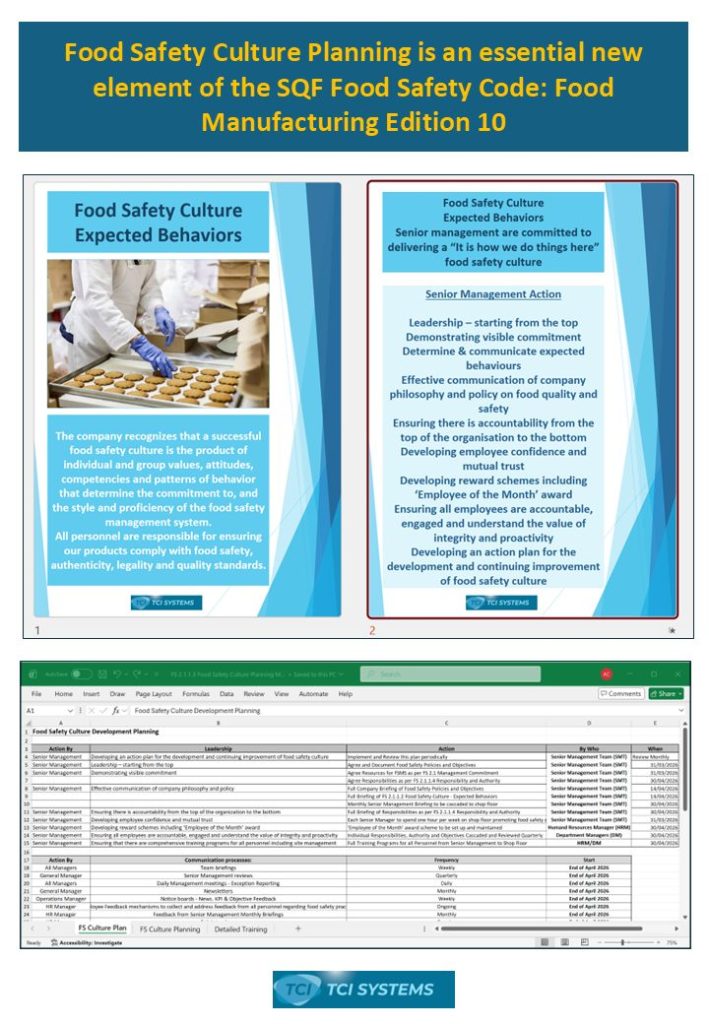
SQF Food Safety Code Edition 10 Clause 2.1.1.3 New Requirement: A food safety culture assessment plan to drive continuous improvement shall be documented, implemented, and maintained.
This plan shall address at a minimum:
i. Effective communication strategies to ensure all personnel are informed and
engaged in food safety practices;
ii. Comprehensive training programs for all personnel including site
management;
iii. Mechanism to collect and address feedback from all personnel regarding food
safety practices; and
iv. Regular measurement and evaluation of food safety-related activities.
About the Author - Tony Connor Bio
After gaining an Honors Degree in Molecular Biology and Biochemistry at the highly-rated Durham University, Tony Connor embarked on a highly successful career in the food industry.
Tony was appointed Laboratory Manager in 1989, Technical Manager of the UK’s largest multi-product dairy facility in 1993 and qualified as a Lead Assessor in 1994.
Over the years, Tony has gained experience in a variety of roles in the Food Industry including leading roles in Processing, Production, Operations, Quality, New Product Development and Technical departments.
During his career, he has commissioned both new sites and brought old sites up to SQF certification standard, helping many SQF Practitioners achieve SQF food safety certification for their organization.
With over 35 years’ experience in the food industry, Tony is a highly-regarded food safety expert and provides food operators both food certification services and hygiene, HACCP and Auditor training.