
The SQF Practitioner’s Guide to Disaster: Crisis Management Template Walkthrough
Having worked most of my 35 years in the food industry in a management role I know the feeling that every SQF Practitioner gets when you receive that “3:00 AM Phone Call.”
Whether it’s a massive power outage, a contaminated raw material, or a natural disaster, SQF Edition 9 Section 2.6.4 Crisis Management Planning requires you to have more than just a plan—it requires a documented, tested, and verified Crisis Management System.
If a crisis hits and your documentation is disorganized, your SQF certification is the least of your worries. Here is our SQF Practitioner’s Guide to the essential templates you need to manage a disaster and satisfy your auditor.
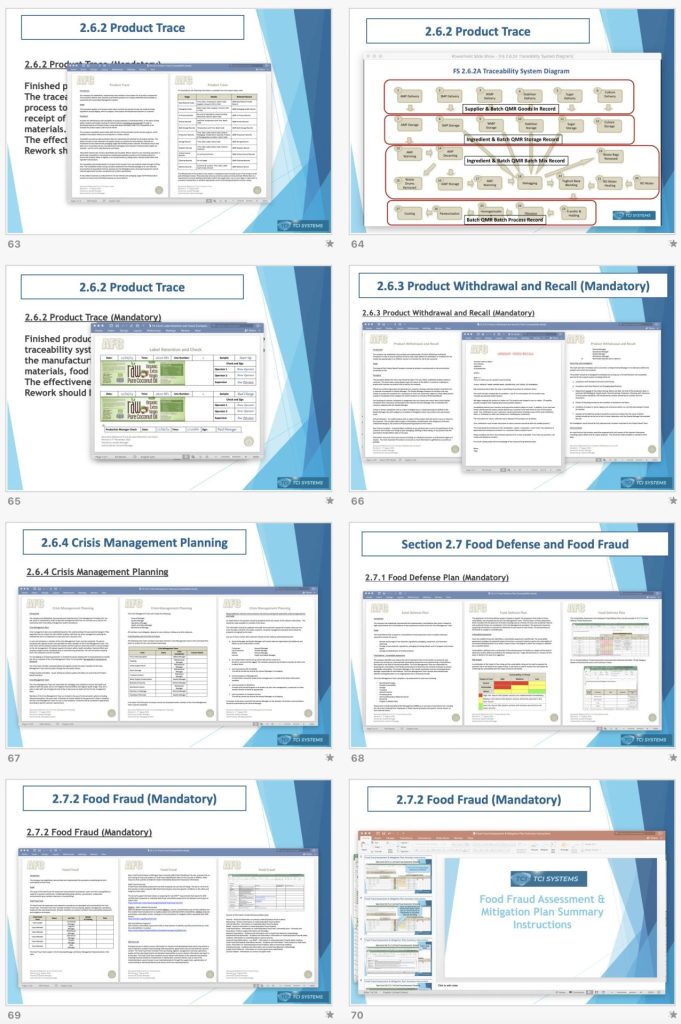
SQF Practitioner’s Guide to Disaster
The Template Requirement: A clear list of names, roles and 24/7 contact information.
The SQF Gap: Most sites forget to list external contacts.
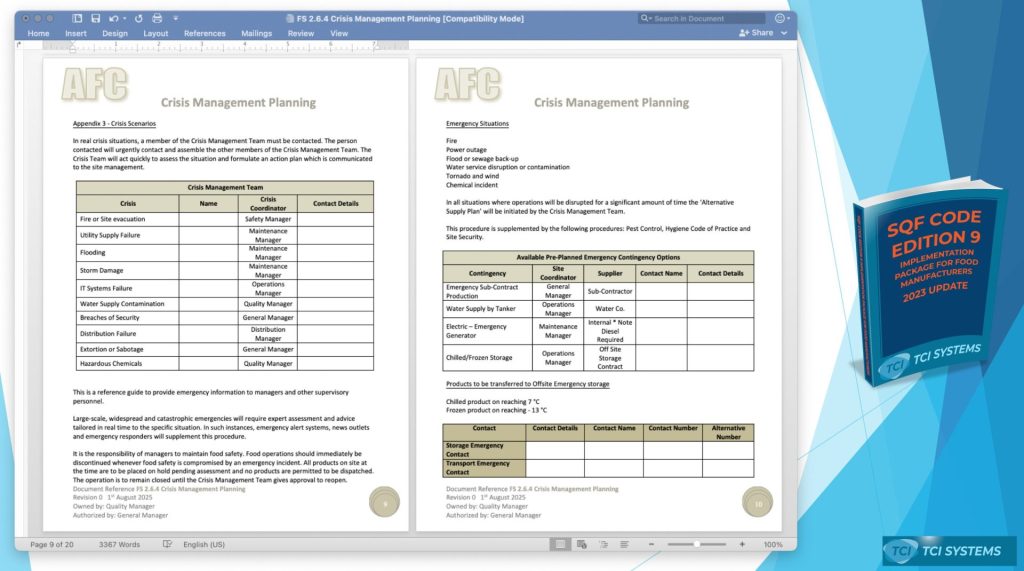
1. The Crisis Management Team (CMT) Roster
A crisis is not the time to wonder who has the authority to shut down a line or talk to the media.
The Template Requirement: A clear list of names, roles (Coordinator, Technical Lead, Communications), and 24/7 contact information.
The SQF Gap: Most sites forget to list external contacts, such as your Certification Body (CB), local health departments, and key legal counsel.
2. The Crisis Risk Assessment
Not all disasters are created equal. SQF requires you to identify “known threats” to your facility.
The Template Requirement: A matrix that evaluates the likelihood and impact of events like:
Loss of potable water or electricity.
Fire
Flooding
Cyber-attacks or IT failure.
Pandemics or labor strikes.
Product contamination or tampering.
The Goal: Prove to the auditor that you have prioritized your response based on the most likely threats to your specific location.
3. Incident Command SOPs (The “Playbook”)
When the power goes out, your team shouldn’t be reading a 50-page manual. You need Action-Oriented SOPs.
The Template Requirement: A “Checklist” format for specific scenarios.
Example (Loss of Water): 1. Stop production. 2. Segregate exposed product. 3. Notify the Water Authority. 4. Verify water safety before restart.
The SQF Requirement: You must define the “criteria” for what constitutes a crisis versus a standard operational issue.
4. The Crisis Log & Communication Record
If it isn’t recorded, the auditor will assume the crisis was handled haphazardly.
The Template Requirement: A chronological log to record:
o Time of the incident.
o Actions taken.
o Decisions made (and by whom).
o Communication Log: Exactly what was told to customers, regulatory bodies, and the Certification Body.
(Note: Under SQF, you must notify your CB within 24 hours of a significant food safety event).
5. Mock Crisis & Recall Verification
SQF requires you to test your plan annually.
The Template Requirement: A “Mock Crisis Report.” This is different from a standard Mock Recall. It should document a tabletop exercise where the team “plays out” a disaster scenario.
The Documentation Goal: Record the “Lessons Learned.” If you didn’t find a flaw in your plan during the mock test, the auditor may think the test wasn’t rigorous enough.
Don't Wait for a Disaster to Build Your Plan
Building a Crisis Management Plan from scratch is exhausting and prone to technical gaps. One missed notification to your Certification Body can lead to a “Major” non-conformity.
The Crisis Management Template provided in our SQF Edition 9 Toolkit provides the framework you need to be “Disaster Ready” in hours, not weeks.
Why our Templates are different:
Pre-Written Scenarios – We provide the “Playbooks” for the most common food industry disasters.
Technical Guidance included – Not sure if a specific event counts as a “Crisis”? Our technical support team is available to guide you. We help you define your thresholds so you stay compliant without over-reporting minor issues.
TCI SYSTEMS
TCI SYSTEMS Heading 3
We are an international supplier of quality management and food safety management systems. We have helped companies and organisations worldwide to achieve the certification of their choice. Our packages have been specifically written to provide a systematic approach to gaining certification.
We are an international heading 5
We have over 20 years experience in food safety and quality management. Our experts have been in the business since the early 1990’s. Their management roles have included laboratory manager, production manager, quality assurance manager, technical and processing manager, technical manager, technical and development manager and group technical manager.
So you can see we have a broad knowledge of departments that operate within a company which is highly valuable when documenting policies and procedures relating to those activities. We also have our own in-house qualified quality management system auditor involved in the creation of these systems. This means that we know exactly what you need to do to meet the requirements of these standards.
Our premium packages include unlimited email support throughout the whole certification process. You will essentially have your very own expert on call for a fraction of the price of an onsite consultant.
About the Author - Tony Connor Bio
After gaining an Honors Degree in Molecular Biology and Biochemistry at the highly-rated Durham University, Tony Connor embarked on a highly successful career in the food industry.
Tony was appointed Laboratory Manager in 1989, Technical Manager of the UK’s largest multi-product dairy facility in 1993 and qualified as a Lead Assessor in 1994.
Over the years, Tony has gained experience in a variety of roles in the Food Industry including leading roles in Processing, Production, Operations, Quality, New Product Development and Technical departments.
During his career, he has commissioned both new sites and brought old sites up to SQF certification standard, helping many SQF Practitioners achieve SQF food safety certification for their organization.
With over 35 years’ experience in the food industry, Tony is a highly-regarded food safety expert and provides food operators both food certification services and hygiene, HACCP and Auditor training.